Showing posts with label Ireland. Show all posts

Wednesday, November 17, 2010

Deficits in Dublin

There are lots of beggars on the streets of Dublin, but only a few are the obvious drunks I’m used to seeing in American cities. Most look in the 20-40 range and many are women. They put a cushion on the sidewalk and sit with their backs against the wall and a blanket over their knees holding out a paper cup. They sit silently or they ask passers-by for change, but they don’t have the ravaged faces, haunted eyes and slept-in clothes of street drunks. They’re dressed decently and look well-nourished. I didn’t give them anything, but some say “thank you anyway” as I walk away.I’d eat breakfast in buffet-style restaurants, sit down next to someone and mention how cold and windy it was. Without my prompting, the conversation would turn to Ireland’s economy. Once people realized I was American, they’d ask about the Tea Party and whether I belonged to it. I explained that there were no forms to fill out, and that people belonged if they worked to shrink government. When visiting Ireland in the spring of 2009, they all asked me if Obama was going to straighten things out, but neither Americans nor Irish put hope in him anymore.On light poles in front of Trinity College were posters calling for violent revolution, and put up by the Socialist Workers Party. If the SWP were anything like I remembered it in Massachusetts during the 1970s, they weren’t much of a threat to civil order. A look at their web site indicated they hadn’t changed much.

A British newspaper, The Observer, said last week about Irish economist Morgan Kelly of University College Dublin: “Kelly . . . was laughed at, scorned and even threatened when he correctly predicted, as long ago as 2007, that Ireland's property bubble was heading for a spectacular explosion. Now he is forecasting mass mortgage defaults and an ugly popular uprising. The first stirrings are already visible, he says, with ‘anxiety giving way to the first upwellings of an inchoate rage and despair that will transform Irish politics . . .’”

“People are angry,” said a middle-aged custom-guitar maker I met in an O’Connell Street pub, “very angry - and they can’t express that directly at the ballot box the way Americans did last week. They vote directly on government only every seven years, and the last election was two years ago.”

“There could be a vote of ‘no confidence’ though, right?” I suggested. “That would bring elections sooner, wouldn’t it?”

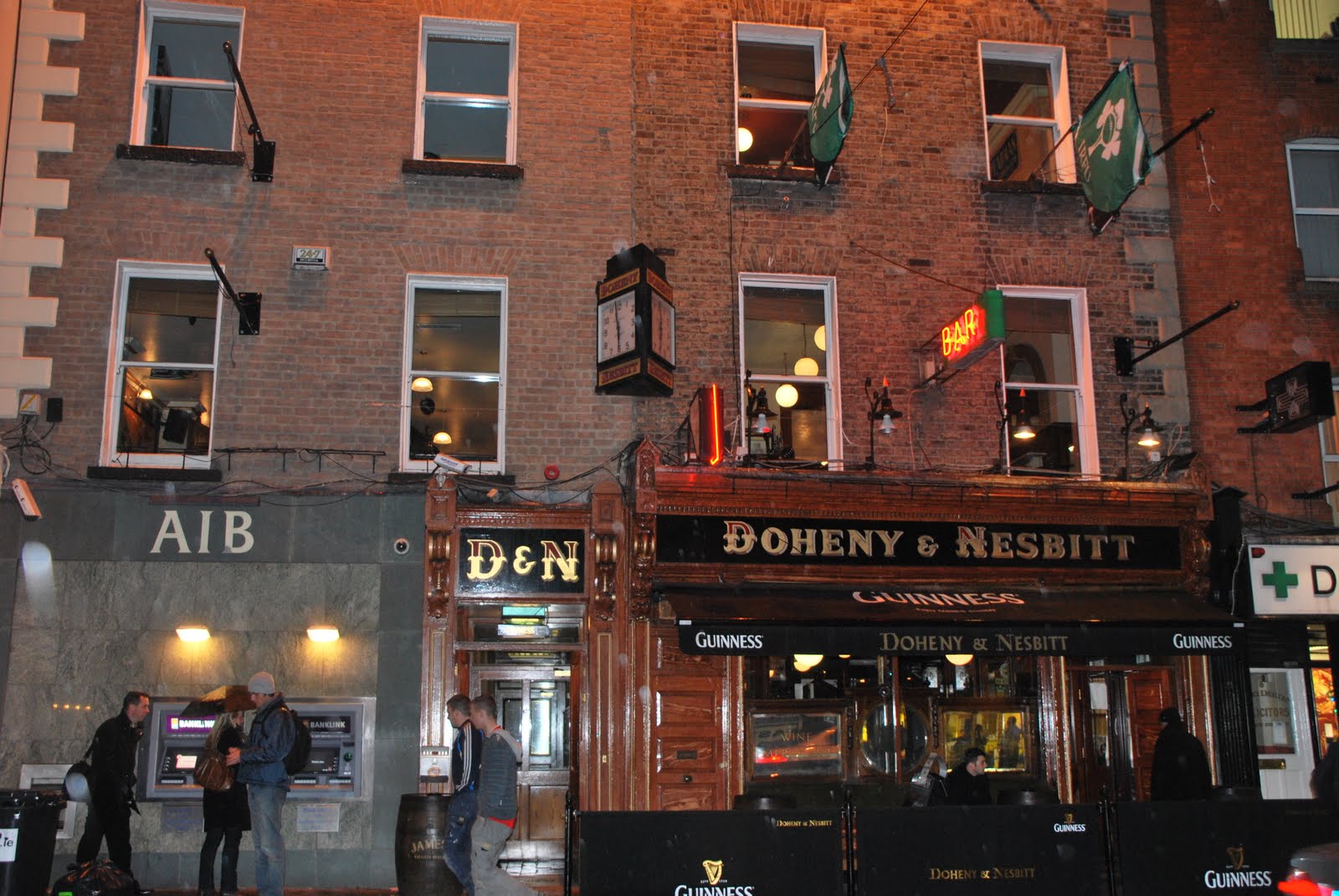
“Yes, but it would require a vote by the MPs, not ordinary people.” He seemed to be suggesting that another kind of protests might occur in the interim, but he had to go meet someone at that point, and I couldn’t ask him.Irish government employees are accepting pay cuts. People on the dole are accepting cuts in benefits and in medical services. At another pub in the government district called “Doheny & Nesbitt’s” I spoke at length to a just-retired, big-government liberal. He was critical of bankers for over-extending as they rode the real estate bubble, but he could not conceive of government leaving them alone to fail. When I suggested his government could have refused a bailout he was incredulous, looking at me like I had two heads. “Well, then the banks would just collapse,” he said.

“Uh-huh. But then taxpayers wouldn’t be on the hook for banker foolishness. Investors and depositors would - but they’re the ones who chose to put their money into those particular banks, right? So, oh well.”

He paused and looked as if he were just considering that option for the first time. “Yes, that might have been possible,” he said, “but government did step in - as it had to - and here we are.”

I snapped a photo of patrons on the sidewalk as I was leaving. One government type turned his head around and said, “Come over here, will you?” He seemed much like politicians in America: dark suit, sharply-creased pants, long black or navy blue long woolen coat, hair spray, and an arrogant manner. “I own that image,” he said.“Is that so?” I answered. “But it’s in my camera. How do you propose we resolve this?” I stared at him defiantly. The men around him went silent for a second or two, until one of them said: “He’s American. He’s not a journalist,” and he held his hand out to me. I shook it. “We’re pretty tense lately,” he said. “It’s that bitch in Germany.”

“Angela Merkel?” I said.

“Yeah, her, if she is a woman a’tall. We thought you were a journalist.” I thought it prudent not to mention that I was a columnist in America.

“No worries,” I said, and he patted my shoulder. His arrogant friend walked back inside without speaking. We chatted like old buddies for a while until I went on my way.

In the hotel bar where I was staying, I had a brief conversation with the hotel-owner’s son and I made the same suggestion: that the Irish government should have just let the banks fail and refuse to bail them out. “But then a lot of ordinary people would lose their money,” he said.

“Uh-huh,” I said, and he looked at me like I was Ebenezer Scrooge. “What’s the unemployment rate in Ireland?” I asked him.

“Somewhere around 13% I think,” he said.

“Wow,” I said. “That’s higher than the official rate in America. If people are laid off, does government provide them with assistance?” I asked.

“Oh yes,” he said. “Of course.”

“Well,” I said, “In our country someone ‘collects unemployment checks’ as we put it, but those checks run out after 99 weeks.”

He looked appalled. “But what will people do then?” he asked.

“Scrounge around for work,” I said. “Rely on family - on the kindness of strangers - whatever they can,” I said.

“But how will they make their mortgage payments?” he asked.

“Any way they can, or face foreclosure.”The EU is about to step in and impose reforms as they did in Greece. Will the Irish riot as the Greeks did? They have a long history of armed rebellion - much of it quite recent. That was against Great Britain which they perceived as a foreign invader, though it had ruled Ireland for centuries. Will they revolt against their own, democratically-elected government? I doubt it, but we’ll see.

The custom-guitar maker said, “With this crisis, we Irish are only proving we’re incapable of governing ourselves. There are tough times ahead.”

Saturday, November 13, 2010

Mountains and Monasteries in Wicklow

Been talking politics and economics in Dublin. I sit next to people in breakfast shops and in pubs and strike up conversations. I don't have to bring it around to the above subjects because they do. It's depressing. It's also been cold and windy for a few days, so when sun was forecast for Saturday I took a bus into the Wicklow Mountains. Trouble is, it started raining as soon as I got there.Took all these photos at the extensive Glendalough Monastery ruins in the heart of the Wicklow Mountains. I went around by myself, but I overheard a tour guide tell his group that Jesus was Irish. “How do I know that?” he asked. “He had eleven drinking buddies and lived with his mother until he was thirty-three.” Sacrilegious? Maybe, but funny.

The sensor on my Nikon D-60 is sensitive enough to pick up plenty of light on overcast, rainy days, and for that I’m grateful. I knew I was framing some beautiful scenes while resting my umbrella on my head as I adjusted my lens, but I wasn’t sure how they’d come out. I’m very pleased. The sun emerged as the sun was setting and offered some mist to hang over the mountains on one side of the long valley.Vikings had raided this monastery every 20-30 years for centuries before Brian Boru defeated them. I wondered how many slaughtered monks lay under these stones.The wind-twisted cedar struck me. It's not hard to see where the prevailing wind comes from as all the trees - and even the gravestones - seem to lean north. This tree symbolized the Viking violence monks endured for so long. The Vikings would wait long enough between raids to let the monks rebuild and accumulate more things to steal.St. Kevin liked to get out of the city too and he went to Glendalough sometime after 500 AD to find refuge from the outside world. These stones on a mountainside overlooking Glendalough's upper lake (or "loch" as they say here) are all that remain of his "cell." It's assumed that he had a stone beehive structure on the site similar to the ones found in Dingle and dating from about the same time.Always been drawn to ancient trees, especially those with the general signs of age like moss and curiously-shaped limbs. There were several on the so-called "Green Road" to the upper lake at Glendalough. Some seemed like characters out of the Wizard of Oz.It's an enchanting place, as so much of Ireland is to me. This is my third trip and I don't think it's the last. If Ireland's economy continues to tank, perhaps it'll get even cheaper to travel here. That assumes the US economy doesn't collapse along with it though.After a few centuries and half-a-dozen raids, monks built this round tower to hide in when the Vikings came by. Guess it worked because it's still there.As these pictures attest, Ireland has survived travails for a long time and it will get past the one looming now as well. Can't be any worse than a Viking raid, can it?

Wednesday, November 3, 2010

Dublin's Fair City


All my ancestors come from Ireland, but that doesn’t make me Irish. I’m thoroughly American, but my ancestry has influenced me in many ways. I’ve traveled there twice with my wife to see the farms two of my ancestors left from in County Donegal and County Mayo. Along the way, I’ve had interesting discussions around history and politics at pubs and B&Bs. My wife, though, is apolitical. She’d wait politely for a short while before sending me signals that she wanted us to be on our way. After several such episodes, she said, “Why don’t you come back by yourself sometime when you can talk with whomever you want for as long as you want about whatever you want?”
Well, that time has come. Last spring, an offer came up: ‘round trip airfare and hotel for four nights in Dublin for $500. With taxes and fees, it came to more than advertised, but I booked it anyway. I’d spent a day in Dublin on our first trip and I wanted to go back. My plan was to figure out what pubs political types frequented, then drop by and see what developed. In August, however, I was fortunate enough to meet two political science professors from the University of Notre Dame on their way to their Office of International Studies facility in Dublin. They suggested I visit there when I was in town and told me of three pubs where I should find conversation. I won’t, however, fill my time with only academics and government types. If they’re anything like they are over here, they’ll be somewhat out of touch, so I’ll visit blue-collar pubs as well.Ireland has gone from rags to riches to rags again over just the last twenty-five or thirty years. Their economy was hurting badly when we visited with my elderly mother and uncle in the spring of 2009. Everywhere I looked there were unfinished building projects growing weeds and President Obama had just been inaugurated. Just as in America, many Irish pinned their hopes on him. Eating in pubs from Kerry to Mayo, locals noticed we were Americans and asked if our new president was going to straighten out the economy. Uncle Joe is a retired economics professor and a liberal who reads The Boston Globe every day and believes it. He assured them that Obama would make things right while I shook my head. The Irish hoped a rejuvenated US economy would pull them up but, as we all know, that recovery hasn’t materialized. Now Ireland is in danger of default. Things are very bad there, as they are in Italy, Spain, Portugal, and Greece. The EU and the Euro are declining fast while the dollar drags too.

There have been other changes in Ireland as well. The country could be called “post-Catholic” or soon to become so. As Tom Hundley writes in the Chicago Tribune: “As recently as the 1970s, 90 percent of the Irish identified themselves as Catholic and almost the same number went to mass at least once a week; now the figure for mass attendance is closer to 25 percent.” That’s a profound change in a very short time and there are several reasons for it. The Irish church offended people much the way the American church did. As homosexual priests preyed on boys, bishops covered up and transferred them, just as they did in Boston and in other American cities. One Irish priest fathered children and paid hush money to their mother with church funds. Some say their brief affluence steered the Irish away from religious faith as well. Whatever the reasons, shortly after his appointment, Dublin’s Archbishop Diarmuid Martin asked, “Will Ireland be Christian in 2030?”Europe itself is called “post-Christian” as churches are sold to burgeoning Muslim immigrant populations and converted to mosques. Its great cathedrals are virtually empty. Percentage-wise, there are fewer Muslim immigrants in Ireland than in the UK and the rest of Europe, but their numbers are increasing rapidly. Islam is now the third-largest faith in Ireland.

Meanwhile, our State Department has issued warnings to Americans traveling in Europe: “[Radical Muslim] terrorists may elect to use a variety of means and weapons . . . to attack public transportation systems and other tourist infrastructure. U.S. citizens should take every precaution to be aware of their surroundings and to adopt appropriate safety measures to protect themselves when traveling,” they say.

Hmm.

“Adopt appropriate safety measures to protect themselves.” That’s funny. I won’t have any weapons, of course - not even my little pocket knife. Guess I could give them dirty looks. If that doesn’t work, I could bite them or hit them with my camera.

Assuming I arrive safely, I’m going to feel the country of my ancestors again, and try to get an idea about where people there think the world is going. It’s good to get out of my own country once in a while and look back at it through other eyes.

Saturday, September 25, 2010

Rocks

I like rocks. Always have. They're solid. They're old. Each one has a story millions, even billions of years old. If I see an interesting rock small enough, I'll sometimes take it home. If it's too large, I'll photograph it.Saw this one on a hike up Whiting Hill in Lovell, Maine last week. It's white quartz with light brown feldspar - pretty typical for a hilltop in western Maine.Here it is closer up. The black outline of weathering around the crystals pleases me.Like to climb over rocks too, especially along Maine's coast. This is part of the bedrock near Biddeford Pool on the southern Maine coast. Maine has some of the most varied geology to be found anywhere on earth. It's not only interesting; it's beautiful. The amateur geologist in me thinks this is sedimentary, metamorphic, turned up 90 degrees and weathered by the surf.This is just a few yards away, but from another age entirely, and that's how Maine bedrock is. This rock heated and swirled more than the one above it.Only about four feet away is this one in a seam where iron oxidized, creating dark red staining.Looks like chemical reactions I don't understand at all are creating different textures as well.Albany, Maine stone wall I found in an abandoned neighborhood last spring.Carrickabraghey Castle on Isle of Doagh, Donegal where we visited two years ago. My ancestors built this "keep" - all that remains of the 14th century castle that was about ten times bigger than what you see here.It's mostly limestone around that area, but some granitic outcrops are scattered about. Glashedy Island is offshore. Glashedy means "green on top." It's a big rock with ten acres of grass on it. Locals brought sheep out there to graze.View out to sea from inside the keep. I love the way the limestone weathers inside - so different from the granites and feldspars of Maine. Easier to work as well.View out another window.And another.And out a door with my wee wife outside.And a high window.A long beach nearby deposits weathered rocks in terraces. When waves recede, millions tumble against each other. The sounds they make are as charming to the ear as the polished limestone specimens are to the eye. The wee wife has found a beauty to smuggle home. Ireland won't miss it.

Wednesday, May 13, 2009

McDonnell Roots


This column didn’t run for two weeks last month because I went back to Ireland to find the cottage where my great-grandmother, Kate McDonnell, lived. Traveling with me were my wife, my mother, Mary (Haggerty) McLaughlin (84) and her brother - my Uncle Joe Haggerty (90). They knew Kate - their grandmother - when she was an old woman and they were children.

My mother and uncle are spry, but I suspected the red-eye flight from Boston would wear them out. We landed in Shannon at 6:30 am Irish time and, figuring they would need to rest, I arranged an early check-in at a B&B in nearby Doolin so they could lay down while my wife and I toured the Burren and the Cliffs of Moher. Instead, they opted to come with us. We toured County Clare all day and came back to O’Connor’s Pub in Doolin that night. After dinner and a couple of pints of Guinness, I was nodding off and I had to drag the two senior citizens out of the pub so I could go to bed. They had more staying power than I did.

The next morning, we took a ferry to the Aran Islands. Weather was unusually good and Joe said it was the best day of his life. Aran natives speak Irish (Gaelic) as a first language, but switched to English as they graciously answered our questions. The next day, we toured Connemara in County Galway. Day four, we toured County Mayo, then went to a pub while my wife climbed Croagh Patrick in the drizzle - a mountain that looks just like Baldface in Chatham, NH. On day five we arrived in Crossmolina.

Great Grandmother Kate McDonnell left a village near Crossmolina in County Mayo and emigrated to Wilkes Barre, Pennsylvania somewhere around 1880-85. If people from northern Mayo went to America, that’s where they tended to go because they’d know people who’d gone over before them. I’ve had to reconstruct Kate’s story because a great-aunt’s detailed records were lost in a flood. From what I’ve gathered, Kate wasn’t born in Crossmolina but her father moved the family there “from the south.” South Mayo? South Ireland? We don’t know. The McDonnells went to Crossmolina with another family - the Haggertys or “Hegartys” as they spell it there. Were they poor? Hungry? Politically oppressed? All three? We don’t know. Peter Hegarty evidently wanted Kate McDonnell, but something took him to Donegal. When he returned, he learned Kate had gone to Pennsylvania. He followed her there and married her when she was sixteen. We could think of that as a nice love story, but there’s another version: When Peter went to Donegal, Kate emigrated to avoid an arranged marriage. He pursued her to America and called in the obligation. I’d prefer the first story were true, but who knows? Kate didn’t talk about Ireland. Whatever happened, their first child was my grandfather, John Haggerty, born around 1886. I knew him. He died when I was six.

As was the case last summer when I was in County Donegal looking for Great-Grandfather James McLaughlin’s farm, Mayo people went out of their way to help us find Kate McDonnell’s cottage. Another relative had visited there thirty years ago and found it, but her directions weren’t specific except that it was in a hamlet called “Rathkell” near Crossmolina. There are lots of McDonnells and Hegartys thereabouts, but I couldn’t use the local records because neither Kate nor Peter had been born there, hadn’t died there, hadn’t married there, and didn’t have children there. Also, they left nearly a hundred thirty years ago. However, we found what we believe to be the ruins of her cottage.

The McDonnells and Haggertys interest me because, unlike every other branch of my family, there’s no apparent history of alcoholism. Kate’s father, Mark, had been a schoolmaster banned from teaching, and that jives with Irish history I’ve studied. In their efforts to Anglicize Ireland, British conquerors passed laws prohibiting many aspects of Irish culture such as speaking Gaelic, practicing Roman Catholicism, or teaching Irish history. Most of these “Penal Laws” were repealed by the early 1800s, but discrimination lingered all over Ireland into the early 20th century, and in Ulster into the 21st.

Mark McDonnell taught his own children however, and a good education was unusual in a poor Irish immigrant girl like Kate among Wilkes Barre’s coal-mining families. When her husband, Peter, died at forty of black lung disease in the mines, Kate took her family to Boston so my grandfather wouldn’t follow him into the hole. She placed a high value on education for her children too, and my grandfather was the only one who didn’t go to college. He apprenticed as a cigar roller - a trade that went the way of buggy whip makers. The McDonnell/Haggerty branch of my ancestors were “lace-curtain” Irish, whereas the rest were “shanty” Irish I hate to say, but the more research I do the more that notion is reinforced.

Next I’ll research the Sullivans and the Fitzgeralds, both from the south of Ireland somewhere. Great-grandfather Eugene Sullivan became a cop in Cambridge while Great-grandfather John Fitzgerald played piano in Boston barrooms. Both were known to be over-fond of whiskey. Should be interesting.

Friday, April 24, 2009

Galway and Mayo in the Rain


Got to read about the "Pirate Queen" when I get back home. The remains of one of her castles was behind our B&B on an island in Maam, County Galway. Evidently, she was quite a character. Wonder why I didn't know about her.

More typical Irish weather lately. As one pub keeper put it, "It only rains three hundred days a year." But even when it's raining sideways, sometimes filtered sunshine peeks through and illuminates up a mountainside far off, lending a mystic aura to the landscape.

Some visitors describe Galway as "melancholic" and one can see why. Others praise the solitude and stark beauty. I wonder what it's like living day-to-day in that white cottage in all that lonely countryside.

I pick out routes with remote mountain passes as we make our way north to Crossmolina. We pass lochs with centuries-old sporting lodges built and maintained by British aristocrats and off-limits to Irish tenant-farmers in the old days.

As I mentioned last year, memories of the Great Famine permeate the country. If you've forgotten about it for a day, there'll be a memorial beside a lonely road in the middle of nowhere to remind you. In Westport, Country Mayo, is the national memorial - the bronze sculpture "Coffin Ship" with skeletons strung about as rigging.

It's eerie, but poignant. Makes me appreciate the Irish breakfast I ate this morning.

Just got an email from my daughter, Annie. Our next grandchild is a little girl! We'll see her in September.

Life goes on.

Tuesday, April 21, 2009

Aran Islands


One of the most stunning places I've ever visited. We all were thoroughly charmed.

Why all the walls? Behind the horse's head is a "field" of limestone bedrock. According to Thomas Joyce, one of the locals, all the fields were like that until they hauled in sand and seaweed to create the soil - an ongoing process as you can see in the next shot. They broke up some of the stone and built up the walls as boundaries for different plots and to enclose the animals. The walls are higher here than in any place I've seen in Ireland, or anywhere for that matter, and I live in New England.

It all makes me feel lazy. It's even more stunning when you think about what went into making it all.

I promised to get some horse pictures for my daughter Annie

It rained in the morning so we almost cancelled, but then the sun came out and we bought ferry tickets. Joe said it was one of the best days of his life and he's had a lot of them. Let's see . . . ninety times 365 is what?

The sun stayed out all day. I had two pints of Guinness for lunch. So did Joe and Ma. Roseann had a Heiniken. I think I'll have the same tomorrow in Connemara. Very nourishing.

I've taken 410 shots so far. Even Roseann took some. I hate posing and smiling on que, but today I obliged. It was that good a day.