 There are lots of beggars on the streets of Dublin, but only a few are the obvious drunks I’m used to seeing in American cities. Most look in the 20-40 range and many are women. They put a cushion on the sidewalk and sit with their backs against the wall and a blanket over their knees holding out a paper cup. They sit silently or they ask passers-by for change, but they don’t have the ravaged faces, haunted eyes and slept-in clothes of street drunks. They’re dressed decently and look well-nourished. I didn’t give them anything, but some say “thank you anyway” as I walk away.
 I’d eat breakfast in buffet-style restaurants, sit down next to someone and mention how cold and windy it was. Without my prompting, the conversation would turn to Ireland’s economy. Once people realized I was American, they’d ask about the Tea Party and whether I belonged to it. I explained that there were no forms to fill out, and that people belonged if they worked to shrink government. When visiting Ireland in the spring of 2009, they all asked me if Obama was going to straighten things out, but neither Americans nor Irish put hope in him anymore.
 On light poles in front of Trinity College were posters calling for violent revolution, and put up by the Socialist Workers Party. If the SWP were anything like I remembered it in Massachusetts during the 1970s, they weren’t much of a threat to civil order. A look at their web site indicated they hadn’t changed much.
A British newspaper, The Observer, said last week about Irish economist Morgan Kelly of University College Dublin: “Kelly . . . was laughed at, scorned and even threatened when he correctly predicted, as long ago as 2007, that Ireland's property bubble was heading for a spectacular explosion. Now he is forecasting mass mortgage defaults and an ugly popular uprising. The first stirrings are already visible, he says, with ‘anxiety giving way to the first upwellings of an inchoate rage and despair that will transform Irish politics . . .’”
“People are angry,” said a middle-aged custom-guitar maker I met in an O’Connell Street pub, “very angry - and they can’t express that directly at the ballot box the way Americans did last week. They vote directly on government only every seven years, and the last election was two years ago.”
“There could be a vote of ‘no confidence’ though, right?” I suggested. “That would bring elections sooner, wouldn’t it?”
“Yes, but it would require a vote by the MPs, not ordinary people.” He seemed to be suggesting that another kind of protests might occur in the interim, but he had to go meet someone at that point, and I couldn’t ask him.
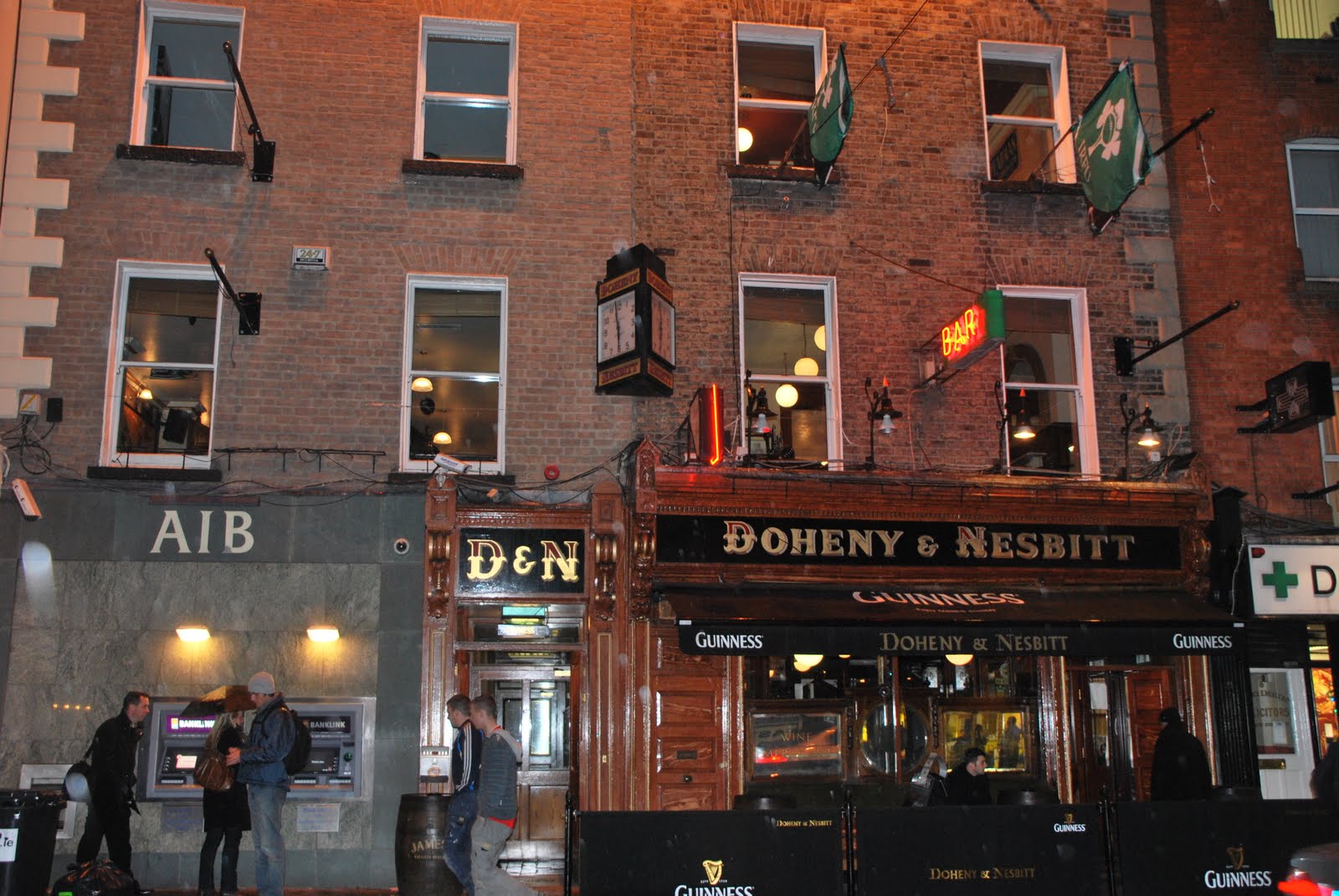 Irish government employees are accepting pay cuts. People on the dole are accepting cuts in benefits and in medical services. At another pub in the government district called “Doheny & Nesbitt’s” I spoke at length to a just-retired, big-government liberal. He was critical of bankers for over-extending as they rode the real estate bubble, but he could not conceive of government leaving them alone to fail. When I suggested his government could have refused a bailout he was incredulous, looking at me like I had two heads. “Well, then the banks would just collapse,” he said.
“Uh-huh. But then taxpayers wouldn’t be on the hook for banker foolishness. Investors and depositors would - but they’re the ones who chose to put their money into those particular banks, right? So, oh well.”
He paused and looked as if he were just considering that option for the first time. “Yes, that might have been possible,” he said, “but government did step in - as it had to - and here we are.”
I snapped a photo of patrons on the sidewalk as I was leaving. One government type turned his head around and said, “Come over here, will you?” He seemed much like politicians in America: dark suit, sharply-creased pants, long black or navy blue long woolen coat, hair spray, and an arrogant manner. “I own that image,” he said.
 “Is that so?” I answered. “But it’s in my camera. How do you propose we resolve this?” I stared at him defiantly. The men around him went silent for a second or two, until one of them said: “He’s American. He’s not a journalist,” and he held his hand out to me. I shook it. “We’re pretty tense lately,” he said. “It’s that bitch in Germany.”
“Angela Merkel?” I said.

“Yeah, her, if she is a woman a’tall. We thought you were a journalist.” I thought it prudent not to mention that I was a columnist in America.
“No worries,” I said, and he patted my shoulder. His arrogant friend walked back inside without speaking. We chatted like old buddies for a while until I went on my way.
In the hotel bar where I was staying, I had a brief conversation with the hotel-owner’s son and I made the same suggestion: that the Irish government should have just let the banks fail and refuse to bail them out. “But then a lot of ordinary people would lose their money,” he said.
“Uh-huh,” I said, and he looked at me like I was Ebenezer Scrooge. “What’s the unemployment rate in Ireland?” I asked him.
“Somewhere around 13% I think,” he said.
“Wow,” I said. “That’s higher than the official rate in America. If people are laid off, does government provide them with assistance?” I asked.
“Oh yes,” he said. “Of course.”
“Well,” I said, “In our country someone ‘collects unemployment checks’ as we put it, but those checks run out after 99 weeks.”
He looked appalled. “But what will people do then?” he asked.
“Scrounge around for work,” I said. “Rely on family - on the kindness of strangers - whatever they can,” I said.
“But how will they make their mortgage payments?” he asked.
“Any way they can, or face foreclosure.”
 The EU is about to step in and impose reforms as they did in Greece. Will the Irish riot as the Greeks did? They have a long history of armed rebellion - much of it quite recent. That was against Great Britain which they perceived as a foreign invader, though it had ruled Ireland for centuries. Will they revolt against their own, democratically-elected government? I doubt it, but we’ll see.
The custom-guitar maker said, “With this crisis, we Irish are only proving we’re incapable of governing ourselves. There are tough times ahead.”


